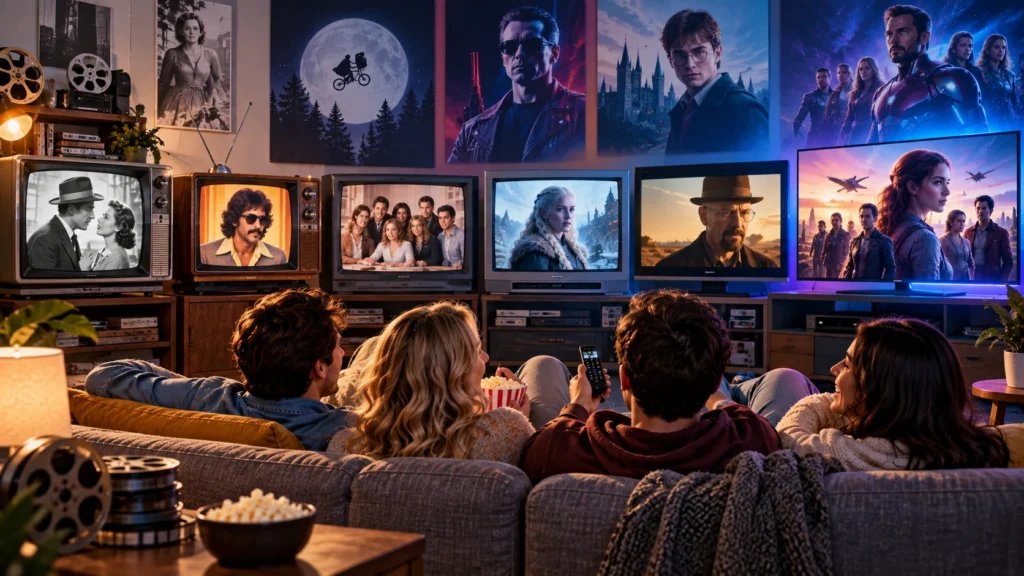
Movies and television have changed dramatically over the past several decades. What began with limited technology, scheduled broadcasts, and traditional film production has developed into a global entertainment industry offering viewers countless choices at almost any time.
The evolution of movies and TV shows has been influenced by technology, changing audience preferences, cultural trends, business models, and the rise of digital platforms. From black-and-white cinema to high-definition streaming, every generation has experienced entertainment in a different way.
The Early Days of Cinema
Early movies were very different from modern productions. Silent films relied heavily on visual storytelling, physical performances, and written title cards to communicate dialogue and important information.
The introduction of synchronized sound transformed filmmaking. Characters could speak, music could accompany scenes, and filmmakers gained new ways to create atmosphere.
Color was another major development. Although color experiments existed earlier, improvements in color filmmaking eventually made colorful productions increasingly common. This allowed filmmakers to create more visually expressive stories and helped establish many of the cinematic techniques audiences recognize today.
The Golden Age of Television
Television became increasingly popular during the middle of the twentieth century. Families often gathered around a single television set and watched programs according to fixed broadcast schedules.
TV shows were commonly divided into recognizable formats, including sitcoms, dramas, news programs, variety shows, and children’s entertainment. Because viewers had fewer channels and limited alternatives, popular programs could attract large shared audiences.
Television also became an important source of news and cultural conversation. Major events could reach millions of households, creating shared viewing experiences.
The Rise of Home Video
The introduction of home video changed the relationship between audiences and entertainment. People no longer had to watch every program at its scheduled broadcast time.
Video cassette technology allowed viewers to record television programs and watch movies at home. Later, DVDs provided improved picture and sound quality and made it easier to build personal movie collections.
This period also helped popularize the idea that audiences could choose what to watch rather than depending entirely on broadcast schedules.
Digital Technology Transforms Filmmaking
Computer-generated imagery and digital production tools changed the possibilities available to filmmakers. Visual effects could create environments, creatures, action sequences, and entire worlds that would have been extremely difficult or expensive to produce using older techniques.
Digital cameras also became increasingly common, making production and editing more flexible.
Modern filmmaking combines practical effects, computer graphics, digital editing, sound design, and advanced cinematography to create highly detailed productions.
Television Becomes More Serialized
TV storytelling also evolved. While traditional television often favored episodes that could be watched independently, many modern shows use longer story arcs that develop across an entire season or multiple seasons.
This has allowed writers to explore characters and complex narratives in greater depth. Audiences may follow a story for years, becoming invested in relationships, conflicts, and character development.
Limited series have also become popular, providing longer storytelling than a movie while maintaining a defined beginning and ending.
Streaming Changes Viewing Habits
Perhaps one of the biggest recent changes has been the growth of streaming services. Instead of waiting for a scheduled broadcast, viewers can select movies and shows from large digital libraries.
Streaming has encouraged binge-watching, where audiences watch several episodes in one sitting. It has also made international entertainment more accessible, allowing viewers to discover productions from different countries and languages.
At the same time, the enormous amount of available content has made entertainment more personalized. Recommendation systems can suggest programs based on viewing habits.
Audiences Have More Choices
Modern viewers have access to movies, television series, documentaries, short videos, animation, live broadcasts, and user-generated content across numerous devices.
Smartphones, tablets, computers, and connected televisions allow entertainment to travel with audiences. A person can begin watching a program at home and continue it elsewhere on another device.
This convenience has also changed expectations. Audiences increasingly look for flexible viewing options and content that matches specific interests.
Entertainment Is Becoming More Interactive
The boundary between entertainment formats is becoming less defined. Social media allows audiences to discuss shows instantly, share reactions, create fan content, and participate in online communities.
Interactive storytelling and audience participation are also creating new ways to experience entertainment.
Looking Ahead
Movies and TV shows will likely continue evolving as technology and audience behavior change. Advances in virtual production, artificial intelligence, immersive entertainment, and personalized recommendations may create new storytelling possibilities.
Despite these changes, the central purpose remains familiar: telling stories and creating experiences that entertain, inform, surprise, or move audiences.
The journey from silent films and scheduled television to digital streaming demonstrates how quickly entertainment can adapt. Each technological and cultural shift has changed not only what people watch, but also how, when, and where they experience stories.